Why Does the Car Feel “Floaty” at High Speed After Installing a Massive Spoiler?
Many enthusiasts install spoilers and vented hoods to make their cars look more aggressive and closer to race cars. However, at highway speeds, the front end feels light, and lane changes come with unstable swaying.
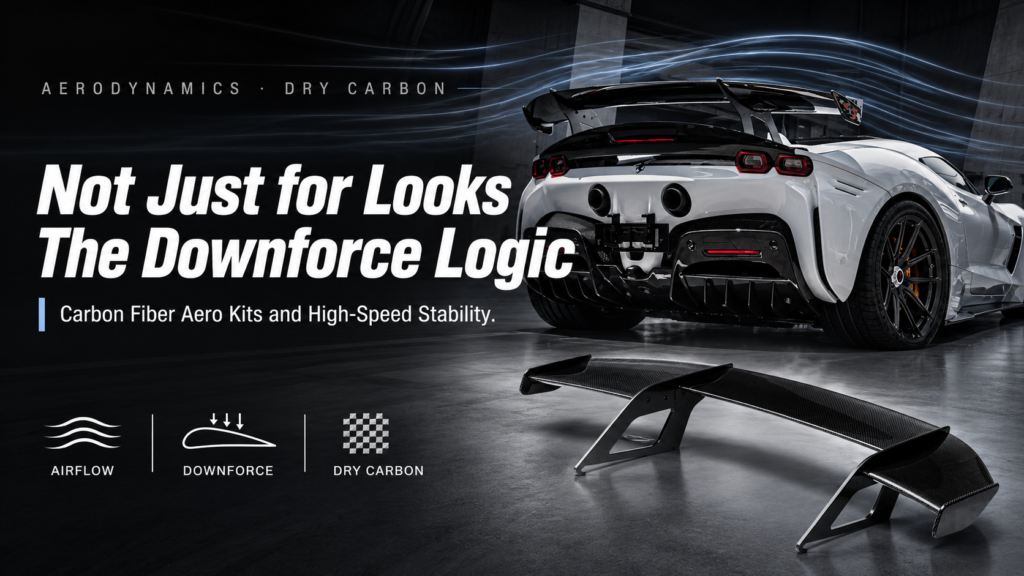
Aerodynamic kits are not just “adding clothes.” Poor airflow management cannot provide downforce; instead, it increases drag and lift, causing negative effects.
This guide breaks down the fluid dynamics of spoilers and hoods to help you understand how downforce is actually generated.
Why Does a Car Tend to “Fly”?
A car’s shape is somewhat similar in profile to an airplane wing. As the vehicle travels forward along the road, surrounding air splits to flow around its body: air passes much faster over the curved roof surface, while it moves comparatively slower beneath the underbody.
According to Bernoulli’s principle, a region with faster airflow generates lower air pressure, whereas slower-moving airflow corresponds to higher air pressure. This pressure gap between the top and bottom of the car naturally creates upward lift force, just like the lift that keeps an aircraft aloft.
The faster the driving speed becomes, the more significant this upward lift grows. As lift increases, the pressing force between tires and the road surface drops accordingly, which directly reduces tire grip. This loss of grip weakens cornering stability, braking performance and overall handling limits at high speeds. The core task of automotive aerodynamic parts is to reverse this unwanted pressure difference, generating downforce instead of lift, and push the car firmly onto the ground to maintain reliable tire contact with the pavement.
The Logic of Spoilers: Inverted Wings and Angle of Attack
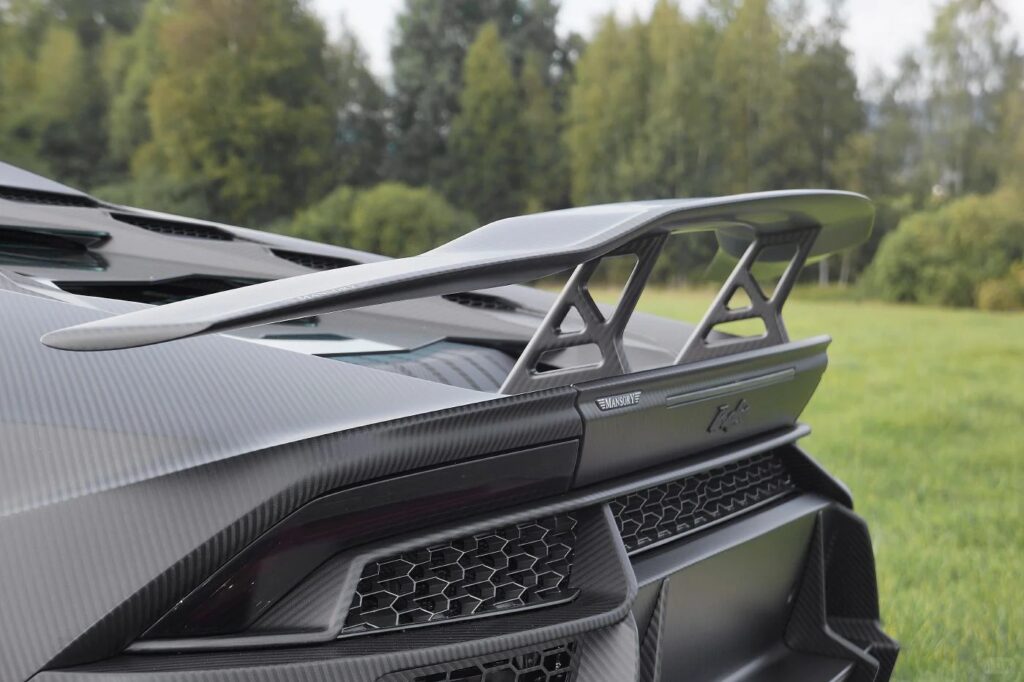
A spoiler is not just an arbitrarily angled flat board. Its cross-section is usually an inverted wing shape, carefully engineered to manipulate airflow rather than merely for visual decoration.
As air passes underneath the spoiler, it accelerates and creates a low-pressure zone. This pressure difference generates consistent downforce, sucking the rear of the car downward and pressing the rear tires tighter against the road surface.
The key to a spoiler’s effectiveness is the “angle of attack.”
The steeper the angle, the stronger the downforce.
But drag also increases exponentially.
If a street car uses a track-level steep angle, it will not only burn more fuel but also severely limit top speed. Additionally, the endplates on both sides of the spoiler are not just for aesthetics.
Endplates prevent airflow from the top and bottom surfaces from mixing, ensuring stable downforce output.
The Secret of Vented Hoods: More Than Just Weight Reduction
The most direct benefit of a carbon fiber hood is weight reduction. But the vents on the hood have a deeper aerodynamic purpose.
At high speeds, the engine bay acts like a sealed box filled with high-pressure air.
Air rushes in from the grille, and if it cannot escape quickly through proper vents and passages, it gets trapped inside the engine bay. This trapped air builds pressure and creates unwanted upward lift under the hood, causing the front end to float and weakening front tire grip at high speeds.
Hood vents allow this high-pressure hot air to escape rapidly.
Lower temperatures: Significantly removes bay heat to protect the engine.
Generate downforce: Creates a pressure difference across the hood for more stable steering.
Why Must It Be Dry Carbon? The Deformation Test Under High-Speed Wind Pressure
When speeds exceed 150 km/h, aero parts endure massive wind pressure.
Ordinary plastic, fiberglass, or even wet carbon tends to deform under heavy load. If a spoiler bends at high speeds, airflow separates.
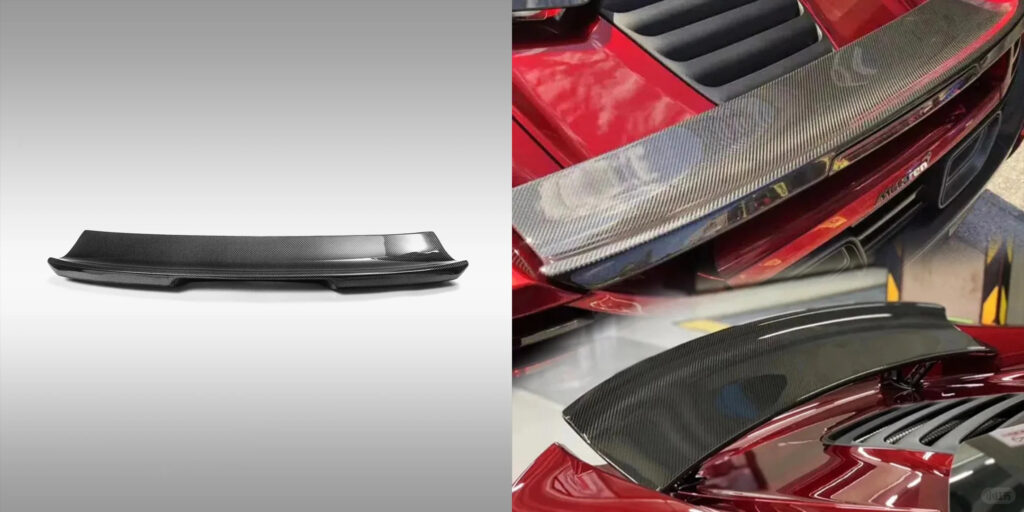
Downforce vanishes instantly and can even turn into lift. The extremely high specific strength and stiffness of dry carbon fiber are the key to ensuring the aerodynamic shape does not deform.
Modification Pitfall: Adding Aero Without Tuning the Chassis
Many owners buy an expensive dry carbon spoiler but keep their old stock dampers.Increased downforce means the tires must handle more vertical load.
Too soft: The car will be pushed lower and bottom out.
Mismatched damping: The added grip turns into body twist and sway.
Aerodynamics Is Science, Not Aesthetics
Good-looking kits are not always functional; functional kits stand up to wind tunnel and track testing.When buying, focus on cross-sectional design, material rigidity, and overall airflow matching to achieve real performance gains.
If you want an aggressive look with real downforce at high speeds, our dry carbon aero kits use autoclave molding.
It ensures rigidity under extreme wind pressure without deformation or vibration.Meanwhile, to match the added downforce, our FS inverted coilovers provide strong lateral support.
The inverted tube design significantly increases bending stiffness, ensuring the suspension firmly holds the body during high-speed cornering.It converts 100% of the aerodynamic downforce into tire grip.
If You Want Aero and Chassis That Withstand High-Speed Tests
Autoclave dry carbon process: Extreme rigidity to resist deformation under high-speed wind pressure
Aerodynamic cross-section: Optimized airflow for real downforce
Precise stock-location molding: Seamless fit, no vibration at high speeds
FS inverted structure: High bending stiffness to support the extra load from aero
Precision damping calibration: Controls body attitude and absorbs high-speed impacts
System-level matching: Turns downforce into actual grip, not body sway
Send us your vehicle model and driving scenario (street or track), and our technical team will match you with the ideal dry carbon aero kit and chassis upgrade setup.